Life of Dave

Life of Dave

Monday, July 29, 2013

Trackside


On July 10 we traveled via InterCity Express (ICE) train from Heidelberg to Berlin. For this portion of our vacation I really wanted to travel on land, as opposed to flying. My Dad lived in the former republic of East Germany for most of his life before immigrating to Canada in approximately 1957, before the Wall was erected. I’m not exactly sure which year it was; his family was always quite secretive regarding details of that time period.

It’s been 24 years now since the dis-mantling of Wall but I was curious to see if I could still tell the difference between the former states of West and East Germany. Twenty-four years would not necessarily be enough time to undue the decline bestowed upon East Germany by approximately 45 years of separation, not to mention the damage inflicted by WW 2. Something else to consider as well is that train routes don’t always travel through the best parts of towns or cities; they skirt past the edges, which can be seedier. We traveled by train from Toronto to New York City once and I remember we never really got to see the best parts of the towns we passed.

However, on this particular journey it wasn’t long after passing Frankfurt (which I knew to have been West German) that my photos begin to depict older style train buildings. Then, after Fulda, which was barely inside the former West state boundary, many buildings begin to look in need of repair.

I tried my best to photograph nameplates on trackside buildings as we passed, but the route we traveled didn’t stop often. Of course the train slowed to pass through urban areas, but it still was not easy to catch a name in a photograph as we sped by. I had to rely on the odd photo with a name, then fill in the blanks later with my notes. I wrote down all the place names I could remember as we passed them if I’d missed photographing them.
 
The first large old-style train station we passed looked reasonably well-kept. I missed the name of the town (between Fulda and Merseburg). 

Then it was industrial-style buildings for a while, including smoke stacks. The first genuinely rundown trackside building photo I have is at Merseburg. I checked online for an East German map, and this town is firmly located in the former East German republic.
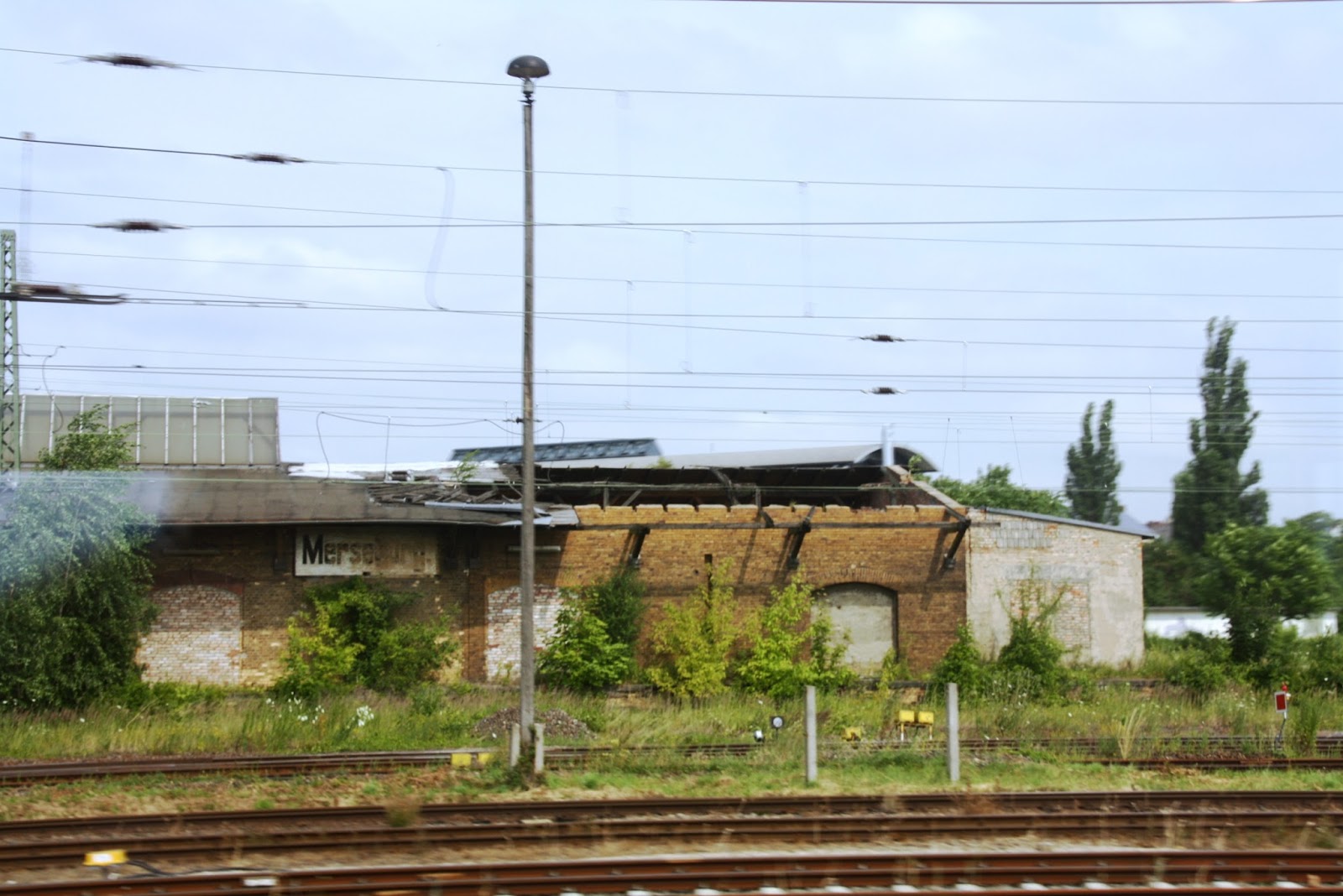
Merseburg
 
Looking around the comfortable modern train car in which we were traveling I noticed most people were not even looking out the windows. Admittedly we were tourists, and being Canadian, rail travel is a novelty (whether that should be the case or not is another subject entirely). Perhaps most others were locals or frequent business travelers. I’ve always been one to have my nose glued to the window on a trip. Even as a small child I never wanted to sleep while we traveled in case I missed something good. The only time I’ve allowed myself to sleep on a trip is in the passenger seat of our car as my wife drove us through Saskatchewan. I don’t think I can be faulted for saying Sask looked much the same at the Western side as it does at its Eastern border.

Approaching Halle I saw many run-down, boarded-up factory buildings. The area began to look more prosperous as the train neared the passenger platform of the station. Buildings within sight of the train platform appeared to be well maintained.
Halle
Past Halle, trackside buildings were in noticeably poorer states is repair. Lots of graffiti, and plant growth taking root in mortar joints between the clay bricks, thus contributing to many low-tech, unintentional "green roofs".


Another trackside building I viewed from a different train was near Madrid. As we pulled into Vallodolid I was pleasantly surprised to see a roundhouse. It appeared to have been unused for many years, but being located in such a hot, dry region of Spain it seemed to be in reasonably good condition. I even caught a glimpse of a train coach inside. It’s definitely a building I would like to have explored. 
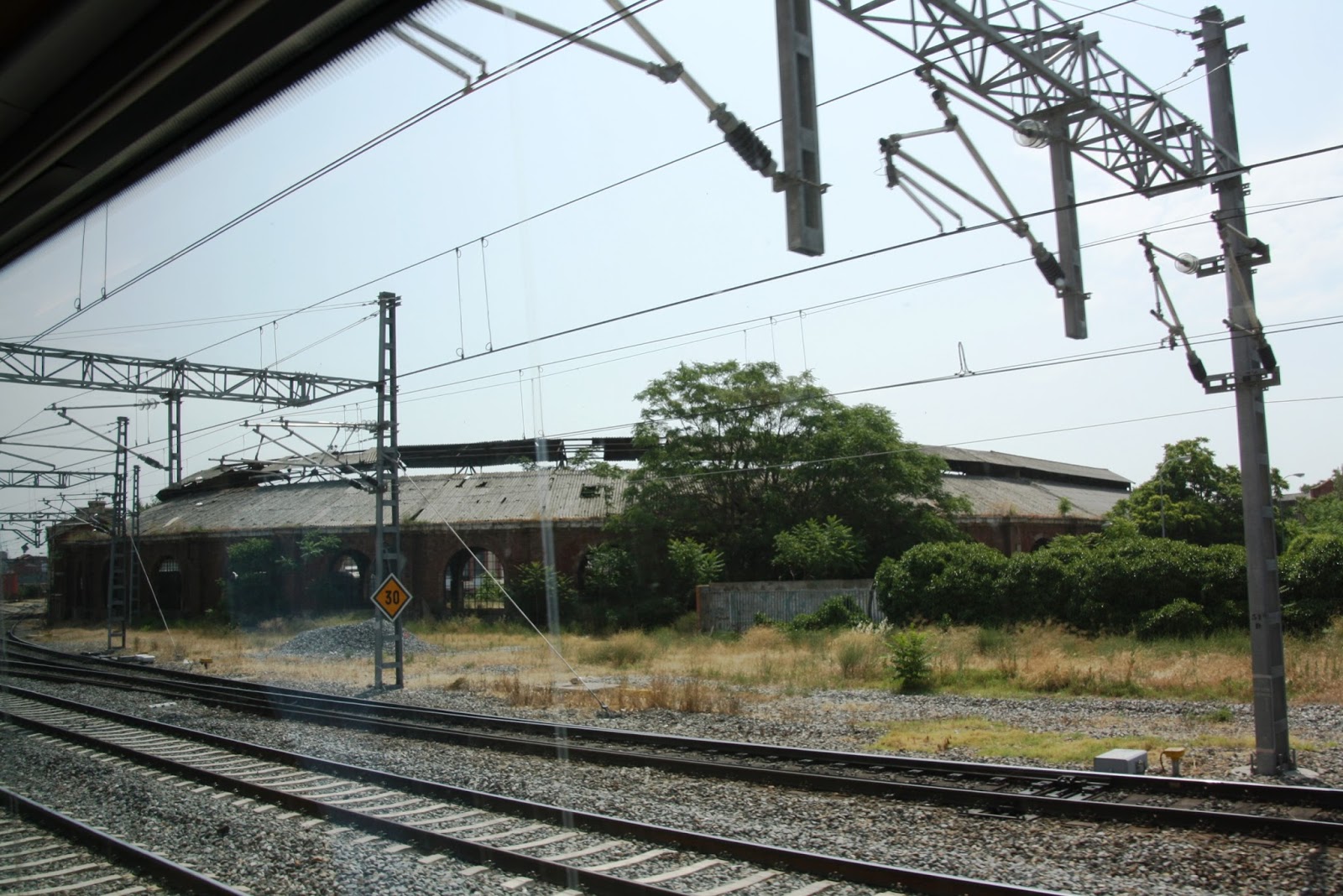
Valladolid, Spain
Valladolid
Valladolid

Tuesday, July 23, 2013

Bahnhof Hunde

I've already been asked what my highlight was of our recent 3-week trip to Europe. We traveled through 4 countries (5 if you count Lichtenstein) and 12 cities, but I keep coming back to dogs being allowed to travel on the transit systems of Switzerland and Germany. Truly the sign of civilized nations!
On a Zurich bus.
On a train to Heidelberg.
Berlin Hauftbahnhof.
Heidelberg Hauftbahnhof.
Berlin Hauftbahnhoft.
Berlin Fredrichestrasse Bahnhof

West Coast Saab-ish

Since viewing Wolfsburg’s impressive display of vintage air-cooled Volkswagens during our recent European vacation it occurred to me that it’s getting more and more difficult these days to create a modified custom that really stands apart from the crowd. In my opinion, the most recent one to stir the pot was Heb Rod, creatively imagined and masterfully constructed by Geoff Peterson a few years ago in Langley, BC. It’s truly in a class by itself.

Within the last couple of years during one of my frequent perusals of Gallery images on The Samba website I came across what I consider to be the perfect combination of vintage air-cooled Volkswagen essence with street rod ingenuity. Why not mount a similar vintage European compact car body onto the floor pan and mechanicals of a Beetle? More specifically, the body of a late 50’s Renault Dauphine. I’ve seen it done a couple of time now and with each viewing I’m more drawn to it. In some ways it’s kind of a dorky-looking Saabish design, but I kinda like the implied Swedish-ness. It also reminds me of a Studebaker or a Kaiser, although at smaller scale.
1950s Saab 93F


Volkswagen had a few coach-built cars constructed in the early to mid-50s, and there were a handful on display in the Wolfsburg museum. These were cars featuring limited edition, hand-built bodies mounted to stock VW running gear. On websites I’ve even seen the odd one customized, but the rarity and corresponding value of one of these cars puts them far from reach. By the means attainable to most mere mortals it would be almost impossible to acquire one now. I would venture to guess that aside from the ones in the Wolfsburg museum, the ones on display recently at Hessisch Oldendorf 2013 (which will also be the same ones displayed at Bad Camberg in 2015), there aren’t too many more existing in the world.

Being of modest means I propose to construct a new “coach-built”. Admittedly such a project involves a lot of metal fabrication work; it’s not for the faint-of-heart. Fortunately Renaults of this model line twinned Beetles in utilizing a rear engine layout with transaxle.

I’ve come across a candidate that seems perfect for my mechanical aptitude and financial status. This one’s had all the hard work done already. It’s a reasonably sound 1959 Renault Dauphine body mounted on a shortened and sectioned VW pan, including VW front and rear suspension and an air-cooled engine. Plus, it’s lowered just right with super-cool Rader rims which happen to be among my favourites, tied with BRMs.

It's always good to have a plan, I say. Not that this car would cost a fortune, but if I won the Lotto tomorrow I'd have the money to clear all the more pressing projects off my plate immedately, and I'd start making arrangements the next day to have Renny delivered to my door.

Two-wheeled Repsols

We just got back from a 3-week trip in Europe. The majority of it was concentrated in Switzerland, Germany and Spain. Throughout our travels I had my eyes open for motorcycles of all kinds, and these countries did not disappoint! Motorcycles are everywhere! I wasn't expecting to see such a large number of Harleys, most of them being Sportsters.I guess it's true: we desire European brands like Porsche/Audi or Ducati. Europeans desire North American brands like Cadillac/Corvette or Harley Davidson.

On our North American shores one model I've been drawn to in recent years is a Honda sportbike emblazoned with Repsol logos. I wasn't even sure what Repsol was; I haven't been paying too close attention since I'm not presently in the market for such a bike anyway.

As it turns out I saw one Repsol-branded sportbike parked in Heidelberg.


Later, in Vallodolid we passed a petrol station (impressive use of European lingo, doncha think?) carrying the Repsol brand. I don't know why I never made the connection before. Makes sense a fuel company would sponsor a motorcycle racing program. These street bikes are street legal replicas of racetrack bikes.


Later that same day I spotted another Repsol-clad bike in Valladolid, however one I wouldn't be so likely to want to ride. Thus far I'm not into scooters.

Currently on Craigslist a few Repsols are listed. This one's a 600cc version, although a 1000cc model is available as well. It's even got the muffler mounted under the tail section. Perfect!

Monday, July 15, 2013

Checkpoint Charlie

We had some spare time before catching the bus/ train combo to the Flughafen so we decided to walk around the neighbourhood surrounding our hotel. As it turns out Checkpoint Charlie was very close by. It’s one of the gates that used to permit access to the American-occupied zone of Berlin. We’d heard reviews of the place that it’s evolved into a tourist trap, but I really wasn’t prepared for the extent of it. There’s actually a McDonald’s restaurant directly across the street from this checkpoint. I’m all for capitalism, but in my opinion a McDonald’s restaurant placed prominently in tourists’ photographs of such a sober reminder of past repression is too much. 

At least that it's not a Hooters.


Checkpoint Charlie, Berlin.